Badami Alone, or the Full Chalukyan Triangle?
Four rock-cut caves carved into a cliff face — genuinely worth a dedicated visit on their own, but most people who make the trip end up wishing they'd budgeted for Pattadakal and Aihole too.
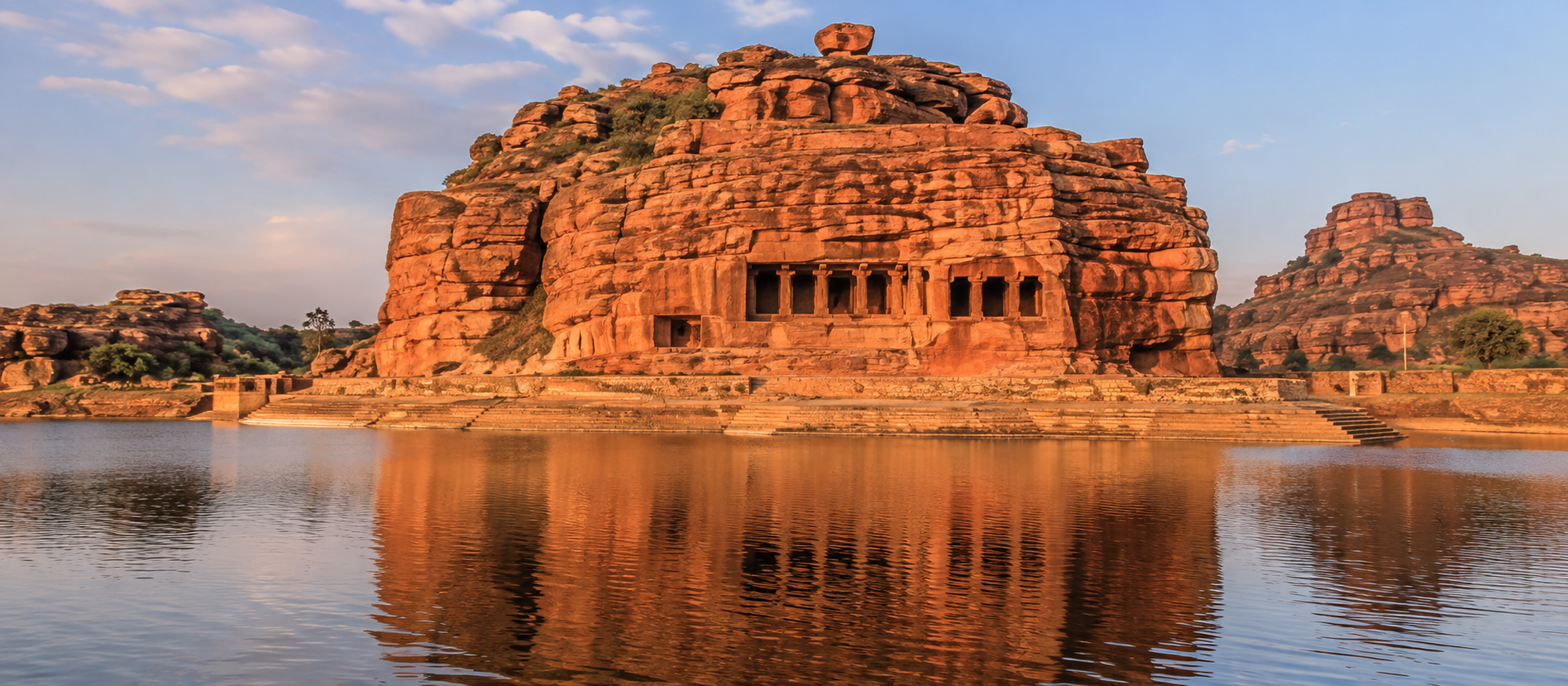
Badami
Is Badami Worth Visiting on Its Own?
Yes — the cave temples are worth a dedicated visit by themselves. But most travellers combine it with Pattadakal and Aihole, the other two points of what's often called the "Chalukyan triangle" — together they tell a fuller story of how this architectural style evolved, and skipping the other two after coming this far is a common regret.
What's Actually in Each Cave
Badami — formerly Vatapi — was the capital of the Early Chalukya dynasty from the 6th to 8th centuries. Four cave temples are carved into the red sandstone cliff overlooking Agastya Lake, reached by climbing roughly 100-plus steps.
Cave 1 — Shiva
Holds the site's most famous carving: an 18-armed Nataraja striking 81 distinct dance poses.
Caves 2 & 3 — Vishnu
Cave 3 is the largest and most ornately carved of the four, with giant reliefs depicting Vishnu's avatars.
Cave 4 — Jain
The smallest of the four, featuring Jain Tirthankara imagery rather than Hindu deities.
Badami Fort
A steep climb to a hilltop fort with panoramic views — genuinely rewarding, but not recommended for elderly visitors or anyone with mobility concerns. Free entry, unlike the caves.
What's Actually at Pattadakal and Aihole
Historians describe the three sites as a genuine progression, not three unrelated stops: Aihole was the experimental laboratory, Badami the workshop where those ideas were refined, and Pattadakal the finished, mature result — a documented 200-year evolution across the same Chalukyan dynasty, not just a marketing tagline.
Pattadakal — the coronation city
A UNESCO World Heritage Site since 1987, roughly 22km from Badami, on the banks of the Malaprabha River. Ten major 7th-8th century temples (nine Hindu, one Jain) stand on the site where Chalukyan kings were formally crowned — the name itself comes from "Pattabhishekam," the coronation ceremony. The Virupaksha and Mallikarjuna temples are the largest and most ornately carved of the group, with the smaller Papanatha Temple and several other shrines rounding out the complex. What makes the site genuinely distinctive: Dravidian (South Indian) and Nagara (North Indian) temple styles stand side by side here, a fusion architectural historians say appears nowhere else in India with this clarity — Pattadakal was quite literally where North met South, architecturally, thirteen centuries ago.
Aihole — where the experiments began
Roughly 35km from Badami, Aihole is widely called the cradle of Indian temple architecture — home to over 125 temples and monuments built between roughly 450 and 1100 CE, spanning Hindu, Jain, and Buddhist traditions side by side. Two structures stand out specifically: the Durga Temple, notable for its unusual apsidal (semi-circular) floor plan — a genuinely early architectural experiment, built in a style more associated with Buddhist chaitya halls than Hindu temples — and the Lad Khan Temple, considered one of the earliest and most historically important structures at the site. This is where Chalukyan architects tried out ideas before they were refined at Badami and perfected at Pattadakal.
Prefer a Guided Tour?
If you're short on time, don't want to arrange transport and guides between three separate sites yourself, or simply want a professional to walk you through 1,300 years of Chalukyan architectural history, a KSTDC coach tour covers this entire circuit in one organised trip.
North Karnataka — Hampi · Badami · Bijapur
5 days, 4 nights, departing every Thursday from Yeshwanthpura, Bengaluru. Day 3 covers this exact circuit — Banashankari Temple, Badami Cave Temples, Mahakuteshwara Temple at Mahakuta, Pattadakal (Virupaksha, Mallikarjuna, and Papanatha temples), and Aihole (Durga Temple and Lad Khan Temple) — before continuing to Bijapur's Gol Gumbaz on Day 4. Also includes a full day at Hampi's UNESCO monuments on Day 2.
View This Tour
Where to Stay
Hotel Mayura Chalukya, Badami
Close to the bus stand in the centre of town, with a mix of AC and non-AC double rooms across two blocks, plus a multi-cuisine restaurant and bar. Guests consistently mention monkeys around the property — keep food and valuables out of reach in your room and on balconies.
View This KSTDC HotelWhere to Eat
The Mayura Chalukya's own restaurant serves Indian, Chinese, and Continental dishes and is a solid default. Badami town itself, being larger than Pattadakal or Aihole, has a reasonable spread of local eateries — more choice here than at the other two sites on the circuit.
A Central Base for the Chalukyan Triangle
Hotel Mayura Chalukya is well placed for exploring Badami, Pattadakal, and Aihole together. Check availability with us before your North Karnataka trip.